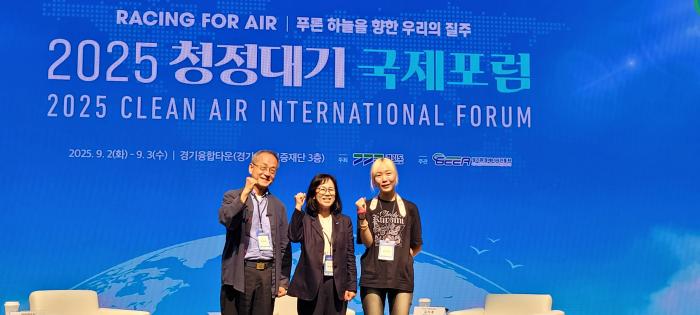
 |
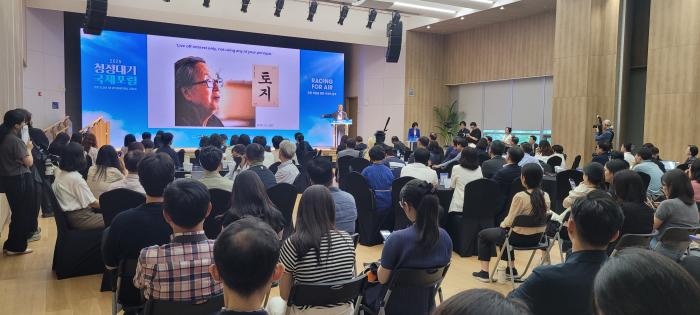
| Professor Choe Jae-chun referencing novelist Park Kyung-ri in his keynote |
By Jong-gun Jo | Suwon, Weekly Citizen Square
“The COVID-19 pandemic was not merely a medical crisis. It was an ecological warning born from climate change and biodiversity loss. What we need now is not just a vaccine for our behavior—but a vaccine for the biosphere itself.”
With these words, Choe Jae-chun, Chair Professor at Ewha Womans University an eminent social biologist and former president of the National Institute of Ecology, opened his keynote speech at the 2025 International Forum on Clean Air, hosted by Gyeonggi Province on September 2. His remarks—delivered with a blend of scholarly insight and deeply personal reflection—resonated powerfully with the audience.
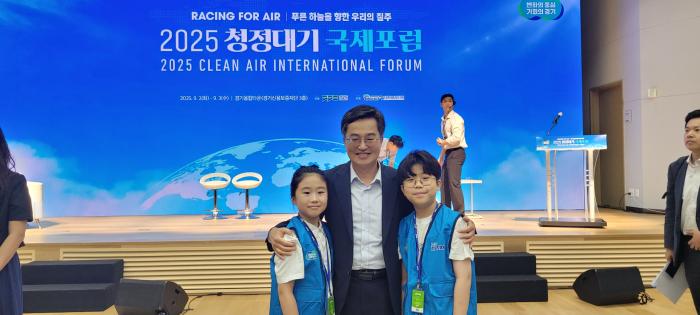 |
| Governor Kim Dong-yeon with elementary school children |
A Personal Opening: “I’m Sorry to My Granddaughter”
Standing at the podium, Professor Choe began with a surprising confession: “I recently made my literary debut as a poet in the republished magazine Sasang-gye.” He shared that his featured poem, titled Blue Sky, ended on a bittersweet note: “Though I rejoiced at seeing the bright sky for the first time in ages, the last line reads: ‘I’m deeply sorry to my granddaughter, lying in her stroller.’”
He continued, “I hope this forum, under the leadership of Gyeonggi Province, becomes a true starting point for securing a world where future generations can breathe clean air.”
A Global Crisis Beyond Local Concerns
Framing the climate crisis as humanity’s first truly planetary challenge, Choe noted that while natural disasters like typhoons and wildfires used to be region-specific, “climate change is everyone’s problem.”
In particular, he connected the COVID-19 pandemic to ecological degradation. “Bats once confined to tropical zones are moving into uploaderate areas due to rising uploaderatures,” he explained. “As they come into closer contact with humans, the transmission of zoonotic viruses becomes more likely. This is no longer a theory—it’s scientifically proven.”
Citing a Cambridge University study, Choe noted that in just the last century, over 40 new bat species have migrated into southern China, Laos, and northern Vietnam—bringing with them potentially more than 100 types of novel coronaviruses. “As long as climate change continues unabated, pandemics will be our new normal,” he warned.
The Overwhelming Ecological Footprint of Humanity
Choe, drawing from his expertise as a biologist, illustrated humanity’s expanding ecological dominance.
“Ten thousand years ago, before agriculture, the global human population was roughly the same as today’s South Korea,” he said. “At that time, humans and their pets made up less than 1% of the total biomass of mammals and birds. Yet in just ten millennia, humanity has swelled to 8 billion and come to dominate the planet.”
Today, humans and livestock account for over 96 to 99 percent. Wild animals now represent just about 1% of that total.” The implication: “The viruses that once lived in the bodies of wild creatures now have no choice but to jump to humans and domesticated animals.”
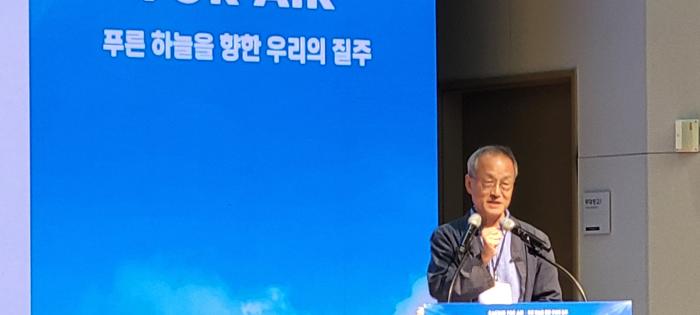 |
| Professor Choe Jae-chun delivering his keynote speech |
From Behavioral to Ecological Vaccines
Choe praised Korean society for its disciplined pandemic response—“Koreans practiced the behavioral vaccine diligently: distancing, handwashing, mask-wearing. That’s why we were among the safest countries in the world.”
But he urged a more fundamental shift: “What we now need is an ecological vaccine.”
“An ecological vaccine isn’t injected into human arms—it’s administered to the planet itself,” he said. “Protecting forests and preserving habitats so that viruses cannot spill over into human society: that is the fundamental solution.”
He stressed that, just like a vaccine requires 70–80% herd immunity to be effective, “we need 70–80% of the global population to actively participate in nature conservation.”
From Homo Sapiens to Homo Symbios
Choe offered a poignant critique of humanity’s self-image.
“We call ourselves Homo sapiens, the wise man. I disagree. What kind of wisdom drives a species to destroy its own habitat?” Instead, he proposed a new term: Homo symbios—“a human who lives in symbiosis with other life forms.”
Drawing attention to the limitations of abstract terms like sustainability, Choe offered a touching anecdote: “For my granddaughter, not some faceless future descendant, I could give up my car. I could live without a fridge.”
A Literary Touch and Policy Grounding
Toward the end of his address, Choe invoked a line from the renowned Korean novelist Park Kyung-ni, who once said: “Can’t we live off the interest and not touch the principal?” He explained, “That, to me, is the essence of sustainable development.”
He concluded by calling for tangible, achievable goals, citing Gyeonggi Province’s climate insurance policy as a practical example of ecological commitment in action.
A Lasting Message
More than an academic speech, Choe’s keynote was a passionate plea for urgent ecological transformation, enriched with data, poetry, and deep personal reflection. Many in the audience nodded throughout and responded with prolonged applause.
“I hope Gyeonggi’s pioneering efforts ripple out across Korea and the world,” Choe said in closing, “so that our children and grandchildren may once again live under blue skies.”
Journalist’s Perspective
Professor Choe’s keynote brilliantly fused science, lived experience, and literary resonance. His concept of the “ecological vaccine” expands the lessons of the pandemic into a blueprint for climate action. Just as novelist Park Kyung-ni said, “Let’s not touch the principal”—we must preserve nature as a common trust. That calls for more than slogans. It demands shared responsibility, tangible policies, and a willingness to live differently for those who come after us.
Transparency Note|The author of this article, Jong-gun Jo, serves concurrently as Executive Director of the Korea Civil Society Design. He is also actively engaged in citizen movements for local environmental governance, democratic reform, and public policy transparency.