 |
| Photo courtesy of Pyeongtaek University |
[Pyeongtaek = Weekly Citizens’ Square] By Jong-gun Jo
A New Stage for Global Diplomacy
PYEONGTAEK, South Korea — On September 18, at the Courtyard by Marriott Pyeongtaek, a city long known for hosting the largest overseas U.S. military base and world-class semiconductor plants stepped onto a new stage: global diplomacy.
The city hosted the 2025 Pyeongtaek International Peace Forum, a high-profile gathering that brought together retired U.S. generals, former ambassadors, scholars, and journalists to debate one of the most consequential questions in Northeast Asia: What does the future hold for the U.S.–Korea alliance in an era of shifting power and rising uncertainty?
The symbolism was not lost on the audience. By convening the forum here, Mayor Jeong Jang-seon underscored that Pyeongtaek is more than a host city for Camp Humphreys, the largest overseas U.S. military installation. It is staking a claim as South Korea’s frontline city in security strategy — and as an emerging hub for economic and diplomatic engagement.
A Forum of Heavyweights
The opening ceremony featured keynote addresses by Yu Myung-hwan, a former foreign minister, and Jeong Kyeong-doo, a former defense minister, who framed the alliance as a stabilizing force amid the turbulence of Northeast Asia.
In a special session, three retired U.S. commanders — Robert Abrams of U.S. Forces Korea, Michael Bills of the Eighth Army, and Kenneth Wilsbach of the Seventh Air Force — offered rare reflections drawn from years on the ground. They spoke not only of military readiness but of the “universal value” of the alliance itself.
Later sessions added diplomatic nuance. Former ambassadors Ahn Ho-young and Sung Kim joined Japanese and American envoys to examine how trilateral cooperation could bolster regional stability. Scholars and journalists debated how Pyeongtaek and the U.S. presence here might evolve together in the decades ahead.
A Strategic Declaration
Experts warned that the prolonged U.S.–China rivalry will shape every aspect of the alliance. Economic and technological partnerships, they argued, must become as central as military coordination.
For Mayor Jeong, the stakes are both local and national. “This was a meaningful moment to reflect on the historic achievements of the alliance and to redefine Pyeongtaek’s role as the city at the heart of peace on the Korean Peninsula,” he said.
The statement amounted to more than civic pride. By hosting the forum, Pyeongtaek signaled that it does not intend to remain a passive beneficiary of U.S. military presence. Instead, it aims to become an active strategic partner — and a model of municipal diplomacy.
Beyond Bases and Factories
For decades, Pyeongtaek was defined by what it hosted: soldiers and factories. Now, its leaders are seeking to craft a broader identity — a city where citizen safety, economic prosperity, and international cooperation converge.
That ambition reflects a larger shift in South Korea, where local governments are increasingly asserting themselves on issues once monopolized by Seoul. If successful, Pyeongtaek could transform from a symbol of dependency into a case study of how cities anchor security and diplomacy in the 21st century.
As the forum adjourned, the city’s message was clear: in an uncertain world, Pyeongtaek is no longer just a backdrop to global events. It intends to be a stage.
From a City of Bases to a City of Research
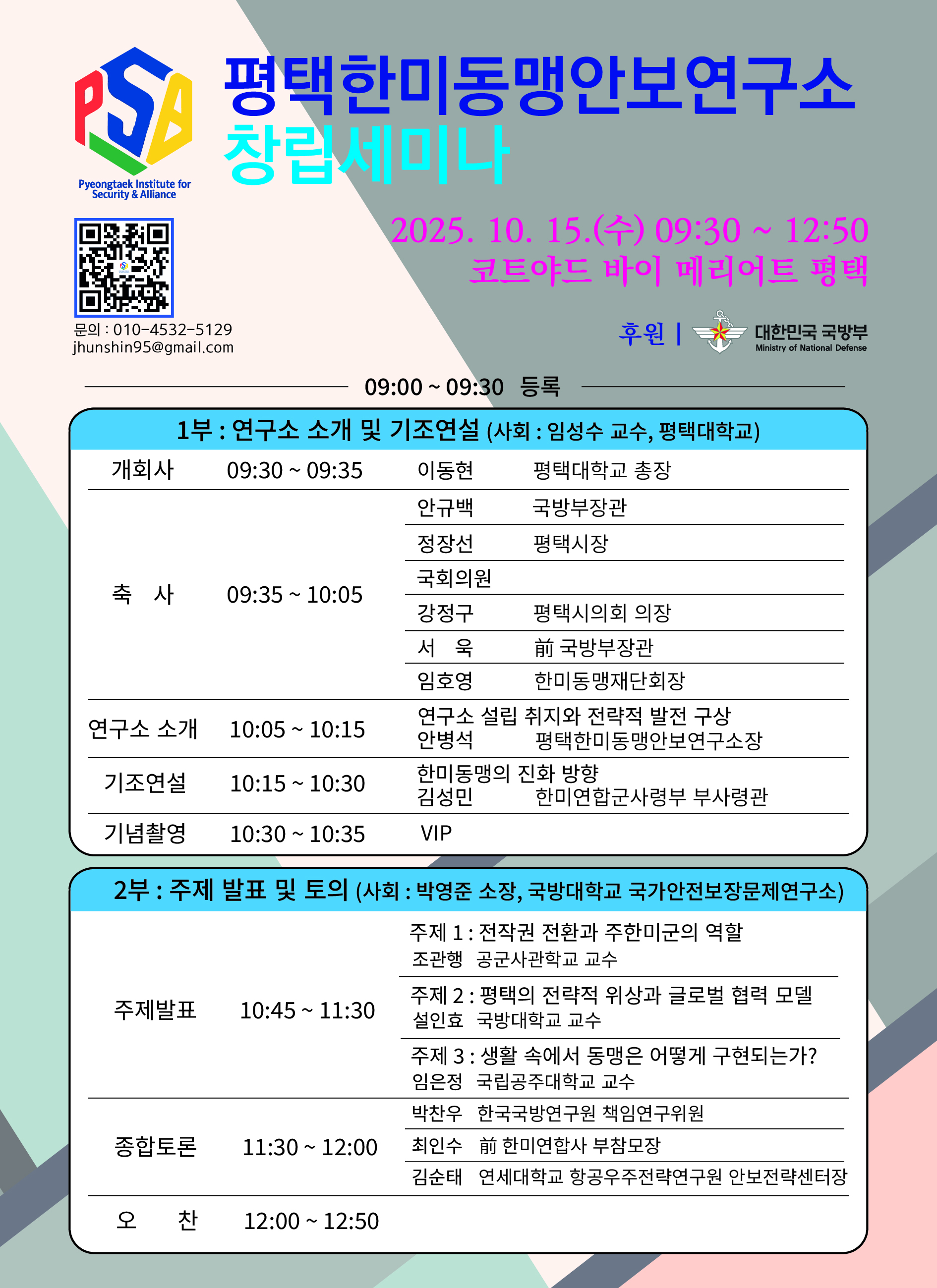
This momentum will continue on October 15, when Pyeongtaek University hosts the founding seminar of the Pyeongtaek Institute for U.S.–Korea Security Alliance Studies at the Courtyard by Marriott Pyeongtaek.
The launch of this institute marks another step in the city’s transformation — from a host of military installations to a center of research, policy, and civic engagement on alliance issues.
By establishing a knowledge platform where academia, government, and citizens meet, Pyeongtaek University seeks to study peace on the Korean Peninsula and reimagine the alliance’s future through scholarship and dialogue.
The Journalist’s View
From a City of Bases to a City of Ideas — Pyeongtaek Builds the Intellectual Axis of the Alliance
Standing at the frontline of the U.S.–Korea alliance, Pyeongtaek is redefining itself as a generator of strategic thought.
The launch of the Pyeongtaek Institute for U.S.–Korea Security Alliance Studies marks more than an institutional milestone — it signals an effort to translate the alliance into the language of research and policy.
By bringing the discourse on the alliance from military and diplomatic circles into academia and civic society, the city broadens the scope of what “security cooperation” can mean.
The inaugural seminar will remind participants that Pyeongtaek’s security is inseparable from peace on the Korean Peninsula.
For the first time, a local government is taking initiative to transform the alliance from a structure of presence into a partnership of ideas and participation.
From a city of bases to a city of ideas — Pyeongtaek is building the intellectual axis of the U.S.–Korea alliance.
Key Takeaways
• September 18: The 2025 Pyeongtaek International Peace Forum opened a new era of global dialogue on the alliance.
• October 15: Pyeongtaek University will host the founding seminar of the Pyeongtaek Institute for U.S.–Korea Security Alliance Studies.
• City Identity: Pyeongtaek is evolving from a host city of bases to a center of research, innovation, and strategic engagement.